Inside the San Siro before it was demolished: AC Milan and Inter players on why the iconic stadium is the best | Football news


Graziano Mannari has a favorite San Siro moment and who can blame him. It came in March of 1989 when he was introduced to his position with AC Milan already two against Juventus. He says: “The crowd was in full celebration mode Sky Sports.
“They were chanting ‘olè’ with every pass we made. The ball was moving around the whole team – Franco Baresi, Mauro Tassotti, Carlo Ancelotti, Marco van Basten – over and over again, and each touch drew another ‘olè’ sound from the stands.
“In my head, I kept thinking, ‘I just want to touch the ball once, to get my ‘olè’ again!’ But the ball didn’t come to me – until Roberto Donadoni hit the perfect ball. I stood up, connected with the diving head, and buried it in the upper corner.
“There wasn’t a cool ‘olè’ song at that moment – the stadium erupted with a huge roar. In that second second, when I landed, I couldn’t believe that I scored. But my teammates rushed to hug me. Later, I scored again to make it 4-0. It was a dream.”
Mannari’s memory is one of the thousands of special moments at San Siro. The following month, the AC Milan team will beat Real Madrid 5-0 in the semi-final of the European Cup, which shows the change of power in the game, and brings the era of Italian dominance in the continent.
In the following year’s World Cup, the San Siro hosted the opening match as Cameroon stunned Diego Maradona’s Argentina. Since its inception in 1926, when Inter won 6-3 against Milan, it has been home to great games, moments and even pictures.
An old photo of Milan’s Rui Costa and Inter’s Marco Materazzi watching as a fire burned inside the San Siro has become iconic. Unity and separation. Good and bad. It provides an overview of the Italian game in a provocative way but also at its most dynamic.
Inter’s famous captain Javier Zanetti played in that game. “It will always be a platform that brings back memories,” he said Sky Sports. “And it brought many victories.” A personal favorite was his debut. “I never thought it was the first of 858 games.”
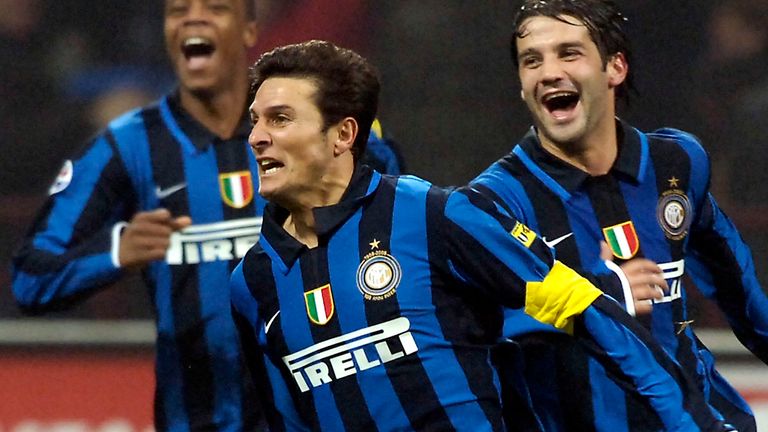
Javier Zanetti is pictured during his playing days with Internazionale
Christian Eriksen’s Serie A debut for Inter came in the Derby della Madonnina. He would go on to score the game winner. “It’s an amazing field,” he said Sky Sports. “Milan ends and Inter ends, different curves. History speaks for itself.”
For Mannari, that history represents football as a high culture. He compares it to La Scala. “Just as the famous Milanese opera hosts the most beautiful performances with great singers, this theater puts on the best shows of the opera,” he said.
But a hundred years after it all started, the clock is ticking at the San Siro. Plans to knock it down. “They’ve been saying that for the last 10 years,” Eriksen said, a little incredulously. But this time the plans are getting bigger after the council approved its sale.
Milan and Inter will now be the owners, sharing rights and responsibilities for the construction of the new stadium, built just west of the San Siro area. “I hope they keep some of the old stadium,” added Eriksen. That’s part of the plan.
An iconic stadium building
His longing for the old place is understandable. Iconic is a word so overused that its meaning has long been diluted but how else can San Siro be defined. While Wembley always had its power, the Maracana too, this place has i a field in the mind’s eye.
Those concrete towers swirling above, the red bands coming out make it look like a spaceship under construction. Some areas are flat for you. The untouched San Siro can be seen for miles around. Like all cathedrals, it is designed to inspire awe.
“When you play at San Siro, the tall stands press against the pitch on all sides, it feels like you’re entering another dimension. You can’t even hear yourself talking to your teammates – you have to shout,” explained Mannari.
“The world moves when the crowd erupts in cheers or whistles of disapproval. It’s truly an indescribable, unique feeling. Unless you’ve seen it in person, it’s hard to imagine. It’s the best stadium I’ve ever played in.”
But what makes it good? That is hard to explain. If one were to draw a stadium, San Siro might be the first attempt but is that because of something born or because of its fame? In the world of soft sports fields, this feels different. And more now.
To meet modern needs
Andrew Edge is an architect who specializes in stadium design. The company he works for, Arup, is currently busy with the renovation of Fiorentina’s new stadium. He is well placed to discuss the aesthetics but also appreciates the role of these amphitheatres.
“Stadiums are an important part of the club’s history but most of the time they have been behind the scenes. However, today we see modern designs that put the stadium on the road of the image or logo of the club making it stand out and be known worldwide,” he said. Sky Sports.
“Stadiums are the platform that allows fans to enjoy those memorable games or events so it’s important that when designing a new stadium you understand the essence and soul of the club and identify those key ingredients that will make that stadium unique and special.”
And not to lose them. Part of the second phase will be used for the construction of the new San Siro. “There are features that people will immediately identify when they think of San Siro. The red roof truss or the spiral ramps for example. They are all part of the stadium’s DNA. You have to acknowledge these special features and use them as inspiration,” said Edge.
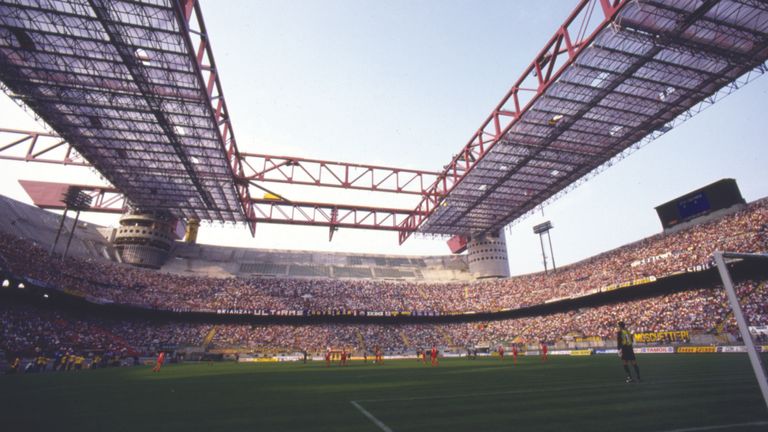
A general view inside the Giuseppe Meazza San Siro stadium in Milan in the late 1980s.
“When you design a new platform it is very important to respect the strong emotional connection that the fans have with the old base. You have to manage the transition and it takes time. It takes time to get used to it, to get used to it, to understand how it works and to start building a relationship or a bond with the new platform.
“To make this change a success it is important that visual reference points and nods to the stadium’s past are integrated into the new design. Personal stories on the walls, pictures of famous players, memories of certain goals or amazing games.
“It’s about how you tell ‘your’ story. That creates emotion, inspires fans, creates an amazing atmosphere and together with iconic designs creates a truly special stadium.
‘A great opportunity for Milan’
“Milan has a great opportunity to create another version of San Siro. It has the perfect ingredients – the unique history of both teams, an iconic stadium to match, all in a global city like Milan with the inspiration of history, architecture, fashion, music and food that will make it all the more special.”
Change is needed. One of the factors that contributed to this is that the San Siro was deemed unfit to host Euro 2032 in its current state. The unimaginable. But it is the result of modernity and the changing needs of the consumer.
“There has certainly been an increase in the development of the structure of the stadium in the last 20 years. Both what we think the stadium is but also what the fans expect when they come to it.
“We are constantly analyzing the fan experience to understand every step of their journey through the spaces we design to their place in the living space. How will the fans interact with the stadium spaces. How will they feel? What will they hear?
“It’s about creating places that evoke emotions and stir the senses. It’s about creating drama and excitement and doing that in an authentic way.
“This pace of evolution is increasing. There is a natural competition between teams and stadium owners to have the most seats or the latest technology. But the world is also changing. Styles are changing. Fashion is changing.
“The expectations of the fans are also increasing. So as stadium designers we have to adapt and respond and design accordingly and build on this flexibility so that the stadium can also improve.
“Clubs are constantly updating and changing their grounds and the experience they offer. Some of these new grounds are less than five years old!” Most of Italy’s reasons are the same as they were in Italia ’90.
‘It will always be at San Siro’
Given that “renovation projects can be even more challenging to bring to today’s standards” a new San Siro was always inevitable. The old venue will host the opening ceremony of the Winter Olympics next month. But we are at the end of the game now.
Even those who have more reason to be emotional about the matter can understand the need for change. “Part of the history is something you will remember but it needs improvement, I think,” admitted Eriksen. While Zanetti, now Inter’s vice-president, was on the message.
“Everything has changed,” he explains. “I believe that a team as important as Inter in the world needs a new, high-quality stadium. The important thing is that it will always be there at San Siro. I hope we will be able to create special memories there as well.”
And the San Siro will echo to those ‘olè’ chants again.


