Six Nations focus on 2026: Can Andy Farrell’s Ireland prove they are not the side to downplay this tournament? | Rugby Union News


Ireland appear to be on the decline as they lose their Six Nations crown to France in 2025. Can it prove people wrong?
Ireland came off the back of a disappointing year overall. After winning the Triple Crown and their first three tournament matches against England, Scotland and Wales, Ireland he opened an unprecedented 142-year streak of winning three consecutive Six Nations titles going down 42-27 to France in Dublin.
Summer wins over Georgia and Portugal set up the second leg of the British and Irish Lions tour of Australia, while November saw defeat against New Zealand and South Africa bookmark wins against Japan and Australia.
In 2026, Ireland will face France and England, as well as home Tests against Italy, Wales and Scotland. Here’s everything you need to know ahead of Ireland’s opening game against France in Paris…
Correction
- France – Stade de France – Thursday, February 5 – 8.10pm (GMT)
- Italy – Aviva Stadium – Saturday, February 14 – 2.10pm (GMT)
- England – Allianz Stadium, Twickenham – Saturday, February 21 – 2.10pm (GMT)
- Wales – Aviva Stadium – Friday, March 6 – 8.10pm (GMT)
- Scotland – Aviva Stadium – Saturday, March 14 – 2.10pm (GMT)
What has changed?
Ireland will say goodbye to three legends in 2025 as Peter O’Mahony, Conor Murray and Cian Healy have all retired.
The men in green also handed out the Six Nations title for the first time since 2022, as France arrived in Dublin and produced a one-sided hammering on the way to lifting the trophy.
Ireland won the Triple Crown in 2025, beating England, Scotland and Wales, but missed out on any chance of the title by not playing against Les Bleus.
The consistency, attitude and behavior of this Irish side has also undergone a sea change. While 2023 saw them play as the best side in the world, Ireland now seem to be moving away from the top of the table.
The difference in Irish training is clear. Between the summer of 2021 and the end of the 2023 Rugby World Cup, Ireland have been shown three yellow cards in 29 Tests – the most of any team in the world. Since the 2023 World Cup, Ireland have been shown 22 cards in 22 Tests – only South Africa have been shown more.
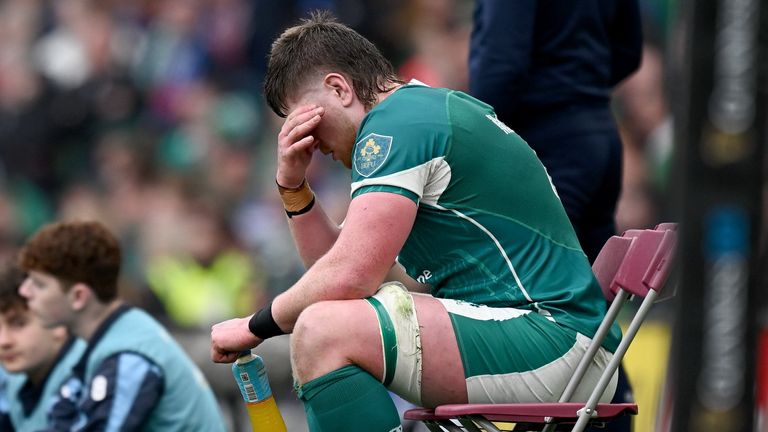
Ireland have gone from one of the most well-behaved teams in world rugby on the cards to one of the worst, as the likes of Joe McCarthy once again do something tragic.
In a significant change of style, Ireland’s possession has dropped to 50 percent in their five Six Nations games, their possession is 54 percent. They scored just 17 tries – France scored 30, England 25 – finishing with the fewest points of any team in converted football (just one try).
Ireland are ranked second from the bottom in meters made and turnovers won, down to fourth in balls made, offloads and breakaways, dead ends from tackles by defenders, breakaways and goal kicks (66.7 per cent, only 59 per cent converted), and at the top of the list are what Opta’s stats call ‘bad passes’ (61).
Ireland have gone from a team that values football, to one that aims to kick to compete.
In addition to the home loss to France, Ireland suffered two defeats during the autumn: a 26-13 loss to New Zealand in Chicago, and a 24-13 loss to South Africa in Dublin.
Another big change sees Andy Farrell return to the helm having missed out on the 2025 Six Nations due to his appointment as head coach of the Great Britain and Irish Lions.
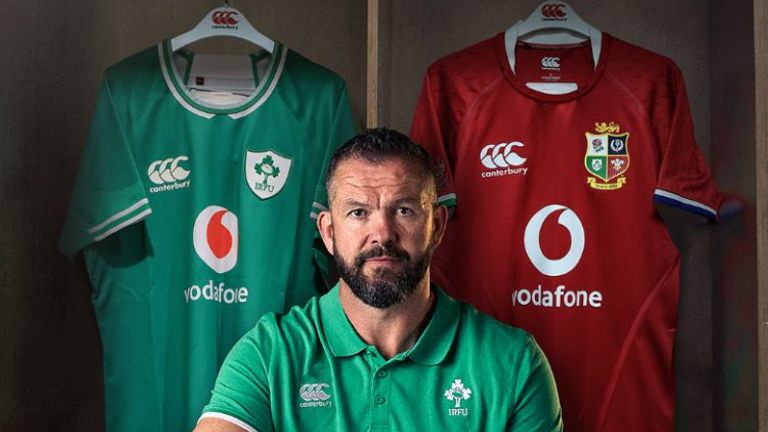
Ireland coach Andy Farrell has missed the 2025 Six Nations due to his second role as head coach of Great Britain and the Irish Lions.
Farrell led the Lions to a 2-1 win in the Australian summer series, with a number of Irish players leading the way for the Lions.
What’s hot?
Much to Ireland’s delight, head coach Farrell is back in the fold.
The 50-year-old has an unquestionable energizing effect on the Irish team, driving their attack, has a reputation as the sport’s best defensive coach, and is a great organizer of quality.
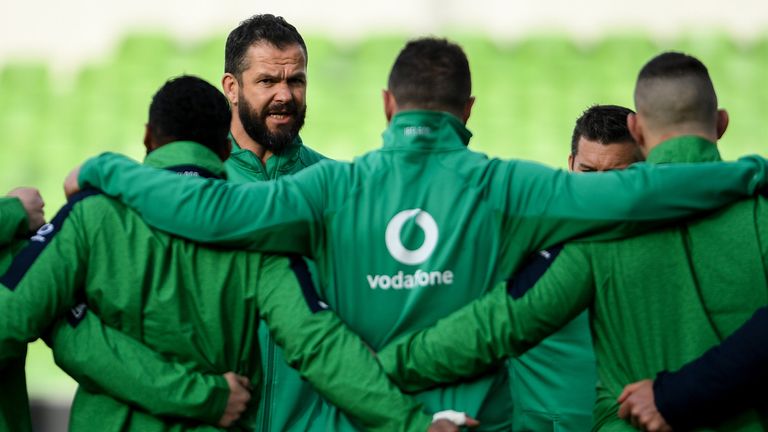
Farrell’s return should prove positive for Ireland, although their 2026 schedule is tough.
Ireland also retained a number of talented players, many of whom gained Test Lions experience over the summer in the series win over the Wallabies.
The likes of Dan Sheehan, Tadhg Beirne, Tadhg Furlong, Caelan Doris and Josh van der Flier – and possibly an aging Bundee Aki – will still entertain many teams in world rugby, although their pool of that level of player appears to be dwindling.
In total, when the late call-ups are counted, 18 Irish players have turned out for the Lions in Australia, with Irish coaches Simon Easterby (defence), Andrew Goodman (attack), Johnny Sexton (kicker) and John Fogarty (scrum).
The IRFU and Farrell will be hoping the experience can help the men in green get back to building the Six Nations.
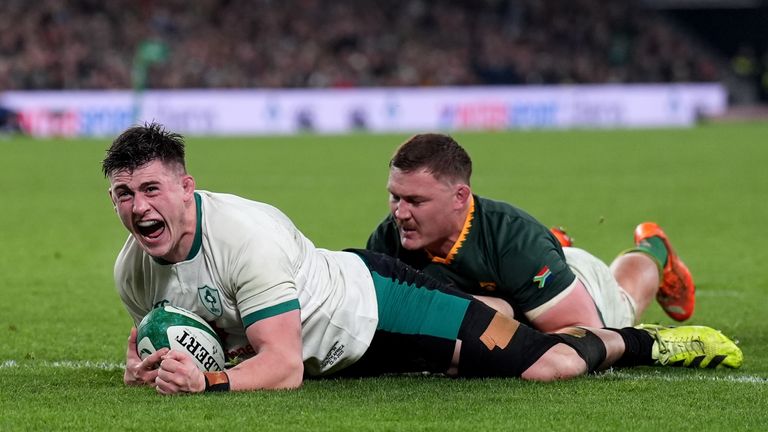
Irish hooker Dan Sheehan is still one of the best players in the world
What is missing?
At this time, it’s too much. In fact, it’s hard to see this current side challenging for the 2026 title these are the issues, especially with tough trips to Paris and Twickenham on the agenda.
As previously detailed, Ireland’s switch to a kick-heavy style of game – with Sam Prendergast coming in at fly-half – did not work and their scrum turned into a dreadful display.
In their defeat to South Africa in November, midfielders Andrew Porter and Paddy McCarthy were both sin-binned for scrum problems, while Ireland were pushed back and under pressure due to a failed set-piece.
During the 2025 Six Nations, Ireland had the worst scrum success, faced with the most success and number of possessions of any side. They also had the worst maul of any side, making fewer meters per game, while only Scotland lost more lineouts.
France and England will head to Ireland’s scrum and lineout in 2026, no doubt.
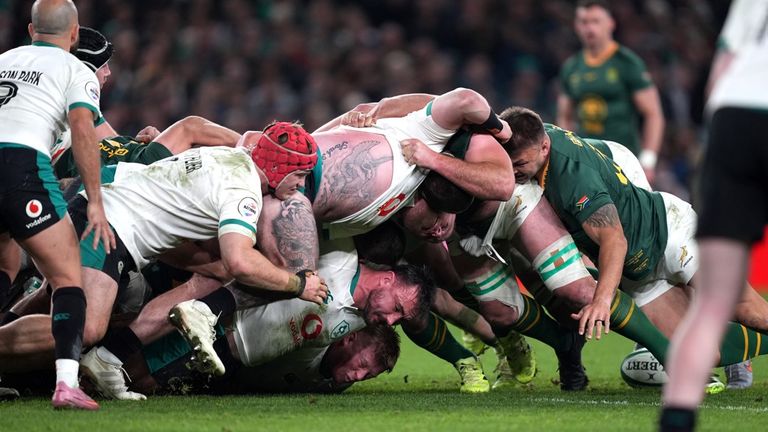
Ireland’s scrum was heavily dominated and dismissed by South Africa in November, posting repeated penalties and two yellow cards.
Another aspect of Ireland’s indolence, while not new but very worrying, is that they are an aging team in many areas and it is starting to show.
At 33, winger James Lowe is playing the worst rugby of his career, having been a key man for Ireland. Scrum-half Jamison Gibson-Park and center Aki turn 34 and 36 respectively in the next few months and lack the consistency of high value.
Backs Jack Conan and Josh van der Flier are 33 and 34, tight ends Finlay Bealham and Furlong are 34 and 33, and midfielders Robbie Henshaw and Garry Ringrose are 32 and 30, all of whom have racked up huge amounts of Test miles on the clock.
There doesn’t seem to be any talent belt ready to step up and take over at this point, or if there is they haven’t been given the opportunity to do so.
In line with the above, the injury is highly dependent on the severity. Mack Hansen, Porter, McCarthy, Henshaw, Ryan Baird, Cormac Izuchukwu, Jimmy O’Brien and Calvin Nash were all ruled out.

Mack Hansen (left) will miss the All-Ireland tournament with a major blow, while James Lowe (right) has struggled for form.
Fullback Hugo Keenan (hip) has not played since the Lions, while Jamie Osborne (shoulder) has not played since November. Furlong, Tommy O’Brien and Craig Casey have also limped off in games.
Finally, Ireland’s biggest selection and position problem remains the No. 10. Munster’s Jack Crowley has guided Ireland to the 2024 Six Nations title but Farrell clearly doesn’t like the way the 26-year-old runs his attack, as periods of solid play have not been rewarded with consistent starting spells.
However, the likes of Farrell, Easterby and Sexton clearly in Prendergast remain deeply flawed – both defensively, and in attacking formation.
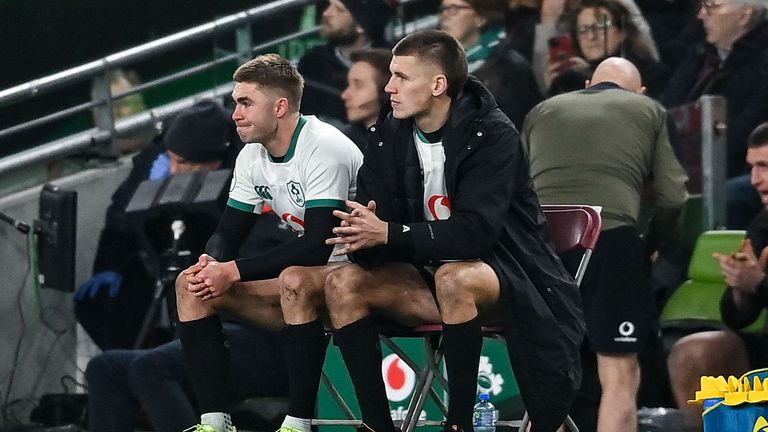
Jack Crowley seems to be disliked by Farrell while Sam Prendergast remains a flawed actor
Harry Byrne has come in from the Leinster cold to cover for Prendergast – maybe he’ll start for Ireland?
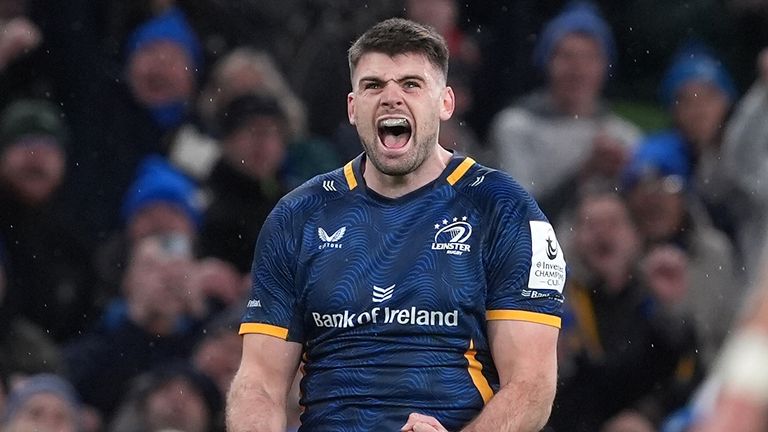
Harry Byrne has replaced Prendergast for Leinster this season and will look to be in strong position to start for Ireland.
Championship record
Six Nations since 2000: Six-time winners (2009, 2014, 2015, 2018, 2023, 2024)
In total: 16 titles directly (1894, 1896, 1899, 1935, 1948, 1949, 1951, 1974, 1982, 1985, 2009, 2014, 2015, 2013, 2020)
Ireland’s 37-man squad for the 2026 Six Nations:
Top (20): Tom Ahern (Munster), Finlay Bealham (Connacht), Tadhg Beirne (Munster), Jack Boyle (Leinster), Thomas Clarkson (Leinster), Jack Conan (Leinster), Caelan Doris (Leinster, captain), Edwin Edogbo (Munster), Tadhg Furlong (Leinster), Ronan Kellemy (Muscle), Ronan Kellemy (Muscle), Ronan Kellemy (Munster) (Leinster), Michael Milne (Munster), Tom O’Toole (Ulster), Cian Prendergast (Connacht), James Ryan (Leinster), Dan Sheehan (Leinster), Tom Stewart (Ulster), Nick Timoney (Ulster), Josh van der Flier (Leinster).
Background (17): Bundee Aki (Connacht), Robert Baloucoune (Ulster), Harry Byrne (Leinster), Craig Casey (Munster), Jack Crowley (Munster), Nathan Doak (Ulster), Tom Farrell (Munster), Ciaran Frawley (Leinster), Jamison Gibson-Park (Leinster), HugoLein Leinlos (James), James Keenan (Ulster), Tommy O’Brien (Leinster), Jamie Osborne (Leinster), Sam Prendergast (Leinster), Garry Ringrose (Leinster), Jacob Stockdale (Ulster).


